When you are looking for a material for your kitchen countertop, the first thing you need to consider is its functionality and second is its aesthetics.

Why? Unlike bathroom countertops and vanity tops, kitchen countertops are more exposed to harsher conditions, which means you need to have a material which has enough strength and hardness to resist chips, scratches, stains, and heat.

In terms of composition, porcelain is mostly made up of kaolinite, also known as “china clay”. Aside from that, it is also made from other minerals such as feldspar, metal oxides, and silica. All these components are mixed and homogenized under extreme heat which produces the porcelain material.

Consequently, the material composition and process of creating porcelain contributes to its sufficient strength, hardness, and resistance to heat. Moreover, considering this is man-made, the variety in design and color can be applied in the last process of its production.

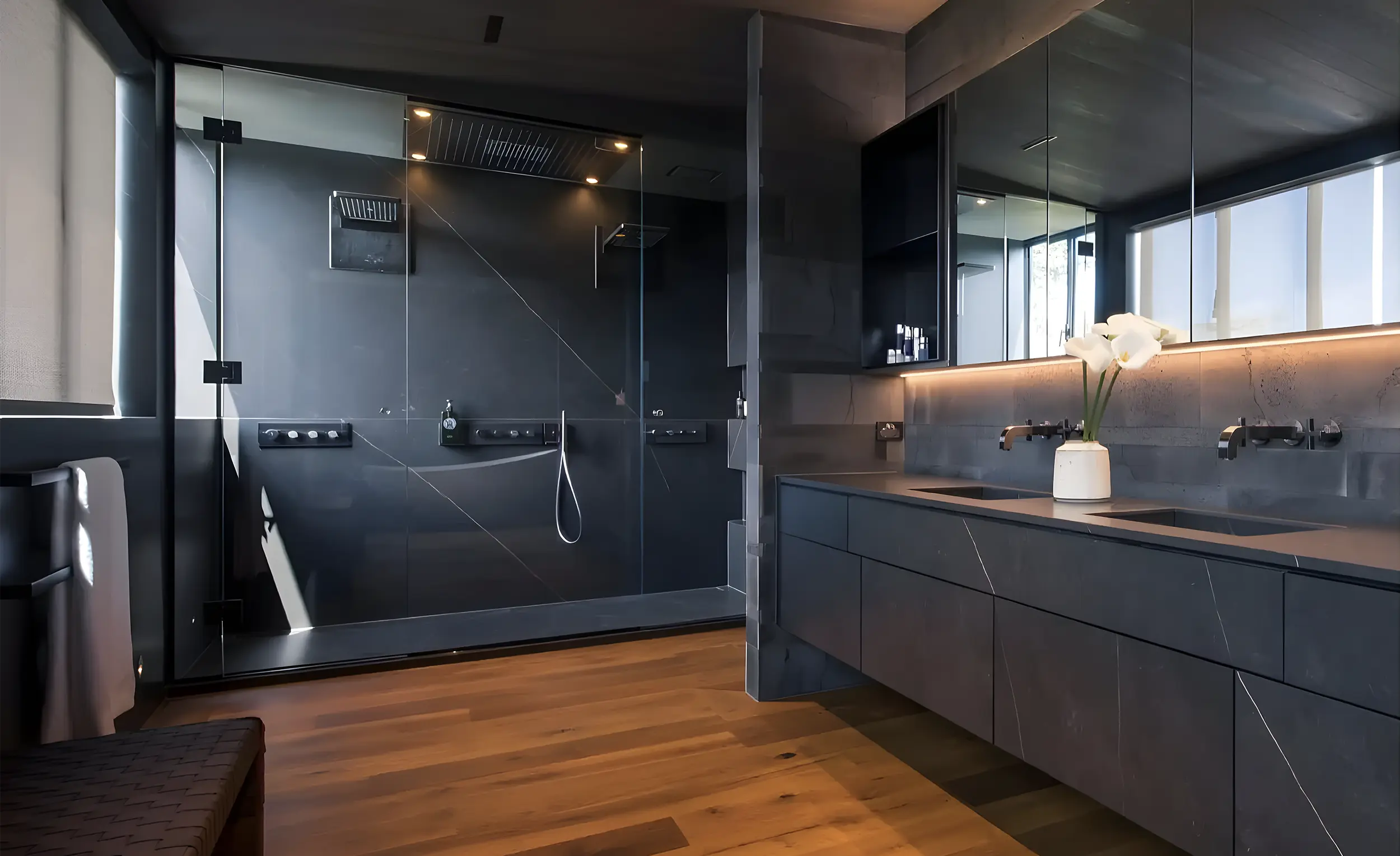
Overall, these things make porcelain slabs a great and rewarding material for your kitchen and bathroom countertops.


Porcelain countertops are large-format, engineered slab surfaces manufactured from refined natural clays, feldspar, silica, and mineral pigments. These materials are compressed and fired at extremely high temperatures, creating a dense, non-porous surface ideal for residential and commercial applications.

At Precision Stone Design, porcelain slabs are fabricated using professional-grade cutting, edge finishing, and installation techniques to ensure long-term performance and clean, modern aesthetics.

Porcelain countertops originated in Europe and have steadily gained traction in the U.S. market as homeowners seek materials that balance durability, design flexibility, and value. Porcelain offers many of the performance benefits of quartz and granite while providing modern slab aesthetics and competitive pricing.

Yes. Porcelain is an excellent kitchen countertop material due to its:

  • Highly resistant to both heat and subzero temperatures due to its dense, non-porous nature
  • Strong scratch and stain resistance
  • Non-porous, hygienic surface
  • Low maintenance requirements

These characteristics make porcelain well-suited for high-use kitchen environments.

Yes. Porcelain slabs are manufactured under extreme heat, making them highly resistant to thermal shock. Hot pans and cookware can typically be placed directly on the surface without causing burn marks or discoloration.

Yes. Porcelain countertops can be used with hidden or integrated induction cooktops, provided the slab, thickness, and installation details are properly engineered. Induction systems heat cookware directly through electromagnetic technology, allowing the porcelain surface to remain structurally stable when installed correctly.

How It Works

  • Undermounting: Induction coils are placed beneath a thin porcelain slab (typically 12mm-20mm thick).
  • Electromagnetic Field: When a compatible pot (magnetized) is placed on the surface, the induction coils create a magnetic field that heats the pot directly, not the countertop.
  • Seamless Design: The result is a smooth, flat countertop with no visible burners, blending into the kitchen design.

At Precision Stone Design, hidden induction installations require early coordination during the design and digital layout phase. Key considerations include:

  • Manufacturer approval of the porcelain slab for induction use
  • Slab thickness and reinforcement requirements
  • Precise cutout tolerances and underside clearance
  • Ventilation and electrical specifications
  • Heat dispersion and long-term performance planning

When properly specified and installed, hidden induction cooktops allow for a seamless, uninterrupted porcelain surface while maintaining full cooking functionality.

Hidden induction systems must be evaluated on a project-by-project basis and coordinated with appliance manufacturers and installers prior to fabrication.

Porcelain is highly scratch resistant and comparable to granite and quartz. However, ceramic knives and similarly hard materials can scratch the surface. We recommend using cutting boards to preserve the finish and avoid unnecessary surface wear.

There is a very similar mineral slab that is being confused with the porcelain slabs, that is, Dekton. Dekton is also known as the “ultra-compact surface” with similar components making up porcelain slabs and is a great competitor with Neolith.

The main difference between Neolith and Dekton with Porcelain slabs lies in its components. Porcelain slabs do not contain a few of the raw ingredients in making glass and quartz slabs, while Dekton and Neolith have it.

Consequently, this makes the two brands much stronger and harder than porcelain

When to Choose Which

  • Choose Porcelain for: Budget-conscious projects, extensive design flexibility (wood looks!), large seamless slabs, simpler installation where extreme heat isn’t a daily issue.
  • Choose Dekton for: Outdoor kitchens, fireplace surrounds, areas with extreme temperature swings, maximum scratch/UV/heat resistance, heavy-duty commercial use, or unique thicker profiles.

Yes. Porcelain slabs can be bookmatched, depending on the manufacturer, slab design, and layout planning. Bookmatching involves placing two adjacent slabs in a mirrored layout so that the veining or pattern flows symmetrically across the surface.

At Precision Stone Design, bookmatching porcelain requires digital slab layout and precise sequencing before fabrication. Because porcelain patterns are printed and often directional, successful bookmatching depends on:

  • Availability of matching slab lots
  • Vein direction and repeat pattern
  • Slab size and application (islands, backsplashes, full-height walls)

When properly planned, bookmatched porcelain can create a dramatic, high-end visual effect comparable to natural marble installations.

Yes. Porcelain is non-porous, meaning it does not absorb liquids. Common kitchen spills such as wine, oil, coffee, or juice will not penetrate the surface, making porcelain one of the most stain-resistant countertop materials available.

No. Porcelain countertops do not require routine sealing. Unlike granite, porcelain’s non-porous structure eliminates the need for annual or semi-annual resealing under normal residential use.

Yes. Porcelain slabs offer excellent resistance to ultraviolet (UV) exposure and will not fade or discolor when exposed to sunlight. This makes them suitable for outdoor kitchens, sunlit interiors, and commercial spaces.

Because porcelain is an engineered material, it is available in a wide range of colors, textures, and finishes —including designs that closely resemble:

  • Marble
  • Concrete
  • Limestone
  • Metal
  • Wood
  • Natural Stone

Porcelain patterns offer significantly more consistency than natural stone because porcelain is manufactured with controlled processes, ensuring uniform color, texture, and design across tiles, whereas natural stone varies unpredictably by nature, with each piece having unique markings. This uniformity makes porcelain ideal for seamless looks, while stone offers unique, organic character.

Most porcelain slabs are available in:

  • Thicknesses: 6 mm (¼”) and 12 mm (½”)
  • Large formats: Up to approximately 10 ft × 5 ft

Large-format slabs allow for fewer seams and a cleaner, more continuous appearance.

Porcelain slabs are thinner and lighter than many natural stone options. In some applications, porcelain can be installed over existing countertops using professional-grade epoxy systems, reducing demolition time and labor costs.

All porcelain fabrication and installation should be performed by experienced professionals due to the material’s density and handling requirements.

Because porcelain patterns are typically surface-deep, edge options are more limited than with full-body stone. The most recommended edge profiles are:

  • Mitered edge
  • Square edge

These profiles preserve the slab’s surface design and deliver a clean, modern finish.

Installed porcelain countertop pricing typically ranges from $55 to $200 per square foot, depending on slab selection, edge detail, fabrication complexity, and installation requirements.

Porcelain generally falls between granite and quartz in overall cost while offering excellent performance and design flexibility.

  • Durability: Comparable overall; porcelain edges require careful fabrication
  • Maintenance: Porcelain requires no sealing
  • Design options: Porcelain offers greater consistency and variety
  • Cost: Porcelain is often more budget-friendly

Porcelain slabs are highly versatile and can be used for:

  • Kitchen and bathroom walls
  • Flooring
  • Fireplace surrounds
  • Outdoor kitchens and patios
  • Shower walls and tub surrounds
  • Vanity tops and cladding

Porcelain countertops are easy to maintain:

  • Clean with warm water and a neutral pH cleaner
  • Use a soft cloth or microfiber towel
  • Avoid abrasive pads or harsh chemicals
  • Wipe dry to maintain surface luster

PORCELAIN SURFACE CATALOG

Aged Clay

Aged Clay

Inquire for price10% OFF

Inspired by the basalt stone, it reproduces an admired design through two shades: cream grey and dark grey. An elegant design that brings us closer to nature, traced with a uniformly grainy background and a diversity of crystalline patterns and sedimentary formations.

Aged Timber

Aged Timber

Inquire for price10% OFF

Dekton is an ultra-sophisticated material & due to its ultra-compact structure, is particularly suitable for installations for indoor & outdoor applications. Some of its features are : Resistant to stains, Highly Scratch Resistant, Resistant to Fire & Heat, Color Stability, Highly UV Resistant, Resistant to Freezing & Thawing, Virtually Zero Water Absorption, Fireproof Material.

Warranty: 25 Year Warranty

Aldem

Aldem

Inquire for price10% OFF

Dekton is an ultra-sophisticated material & due to its ultra-compact structure, is particularly suitable for installations for indoor & outdoor applications. Some of its features are : Resistant to stains, Highly Scratch Resistant, Resistant to Fire & Heat, Color Stability, Highly UV Resistant, Resistant to Freezing & Thawing, Virtually Zero Water Absorption, Fireproof Material.

Warranty: 25 Year Warranty

Arabascato Polished

Arabascato Polished

10% OFF

Stile® Large Porcelain slabs is the latest evolution of porcelain for home and commercial properties. Stile® porcelain slabs are nonporous, etch and stain resistant, and heat resistant, making the material suitable for a variety of kitchen and bathroom projects in both commercial and residential properties.

Aura 15

Aura 15

Inquire for price10% OFF

Dekton is an ultra-sophisticated material & due to its ultra-compact structure, is particularly suitable for installations for indoor & outdoor applications. Some of its features are : Resistant to stains, Highly Scratch Resistant, Resistant to Fire & Heat, Color Stability, Highly UV Resistant, Resistant to Freezing & Thawing, Virtually Zero Water Absorption, Fireproof Material.

Warranty: 25 Year Warranty